When a good tech quits, it hits hard.
You lose more than just a pair of hands. You also lose their experience, momentum, and often the glue that holds a crew together. It’s not just about money, either. Most restoration businesses already spend enough on hiring and onboarding, but the real cost comes after onboarding. Real training, retraining, rescheduling training, and rebuilding trust in the field takes time.
If technician retention is a challenge in your company, you are not alone. It is one of the most common issues in the industry today. With more options available and the work as demanding as it is, technicians will move on if the environment does not support them.
In this article, we will show you practical ways to improve technician retention—from smarter training systems to better communication and leadership. Let us start by understanding why techs walk away in the first place.
The Main Reasons Why Technicians Leave

Most technicians do not leave because of the paycheck. If a technician can’t pay their bills and the pay isn’t competitive, then they may leave. But on average, most techs leave because the job starts to feel like it is going nowhere.
They run the same equipment setups each day. They fill out drying logs but never hear if anything was done well or needs improvement. Weeks pass without a conversation. Progress feels invisible, and motivation starts to fade. Or the only thing they hear is what they need to work on with no actual training on how to improve. A lack of training will result in a lack of buy-in.
Some managers push training off to keep up with the schedule. But a lack of training will slow development. Then, skill gaps start to show. At times techs want to take on more responsibility but never get the chance. Others want a smoother routine or fewer surprises in their day.
When those needs go unaddressed, even loyal techs start thinking about what is next. Not because they are unhappy with the work itself, but because they no longer feel like they are growing.
The Technician Retention Strategies That Work
If you want technicians to stay, you need to build the kind of system that supports them in the field.
Here are five strategies that can help you do that.
1. Help Technicians See Their Progress and What It Leads To
Technicians are more likely to stay when they understand how their work is measured and how it connects to opportunities for growth.
Start by making expectations clear.
What does a complete job look like from start to finish? What details matter most on a drying report? What does “done right” mean on a typical water loss? If these things are unclear, technicians do what makes sense to them, and that leads to confusion or frustration on both sides.
Once expectations are clear, show how meeting them leads to something.
That might be more independence, a schedule with fewer travel hours, or a shot at running a small crew. For some, it might be as simple as knowing that someone noticed. When techs know what matters, and when their progress is recognized, it gives them a reason to keep improving and a reason to stay.
Running a company is similar to a sport. If the score isn’t tracked and tallied then no one would watch. Also, the athletes wouldn’t give as much effort. If there’s no score, then there is no goal. How do you know if you’ve done well or what to work on? Everyone needs to know the score.
In a company, employees should know the score and the goal. Talk about the score during morning meetings and post it somewhere everyone can see it. Talk about the goal and track it so everyone knows how they are doing. Then train to help them reach the goal. When they see progress, see you helping them and then see how their progress is being documented and noticed, they will buy in even more.
2. Learn What Motivates Each Technician and Support Them

Retention improves when you start asking what your team wants.
Some technicians want to lead. Others just want reliable hours and a consistent route. Some are motivated by advancement. Others care more about stability. There is no one-size-fits-all. Assuming everyone wants the same thing is where most retention efforts fall short.
The fix is simple. Talk to your technicians. Not in a formal review, but in the course of the day. Ask what part of the job they enjoy. Ask what feels frustrating. Find out where they want to go, even if they aren’t sure how to say it yet.
Once you understand what matters to them, look for ways to support it. If someone wants to lead, let them coordinate a job or train a new hire. If they need steadier hours, see if your rotation can be adjusted without hurting the team.
What you offer does not need to be big. It just needs to show that you are paying attention. When people feel understood, they become more invested in the work and more likely to stay.
3. Make Training a Part of the Workday

In most restoration companies, training happens when there is time. The problem is, there is almost never time.
Technicians learn things on the job, but it is not always according to standards. One technician might be great at setting equipment but struggle with moisture mapping. Another might know how to demo drywall but avoid the documentation. These gaps build up over time, and they affect performance, consistency, and confidence across your team.
The solution is to make training a part of the daily routine instead of something extra.
When training fits into the day and helps with real situations in the field, people use it. And when they use it, they improve faster and stick around longer.
4. Give Feedback That Helps Technicians Improve
Most technicians want to know how they are doing, but in many companies, feedback only shows up when there is a problem.
Saying “good job” is fine, but it does not help someone understand what they did well or how to repeat it. On the other hand, when something goes wrong and feedback is vague or delayed, it often creates frustration rather than growth.
Useful feedback is specific, timely, and regular. It can be as simple as pointing out when a drying report is especially clear, or when a job is finished faster without cutting corners. It can also be a quiet correction before a bad habit takes root.
This does not require a formal meeting or written evaluation. It can happen on-site, in passing, or during a quick ride between jobs. What matters is that it is consistent and that it comes from a place of wanting the tech to improve and be proud about the work they do.
When feedback becomes a normal part of the workday, it builds trust. And trust is what keeps people open to growth and connected to the team.
5. Protect Technician Time and Safety

Technicians put in long hours in physically demanding conditions, often under pressure to move quickly from one job to the next. Without balance or support, the work starts to wear people down.
Burnout is not always easy to spot right away. It shows up when someone who used to take initiative starts doing the bare minimum, or when mistakes creep in because they are stretched too thin. If those signs are ignored, good technicians will eventually leave, not because they dislike the job, but because it became unsustainable.
Safety can slip for the same reasons. If a technician is rushing through setups or lifting equipment without the right gear, the risk of injury goes up. And when someone gets hurt on the job, it raises real questions about whether the company has their back.
Retention improves when technicians feel protected. That means rotating schedules when possible, watching workload, and holding the line on safety standards. When the team sees that their time and well-being matter, they are more likely to stay committed to the work.
How Reets Drying Academy Helps You Keep Great People
Each of the strategies above becomes more effective when you have the right training system in place.
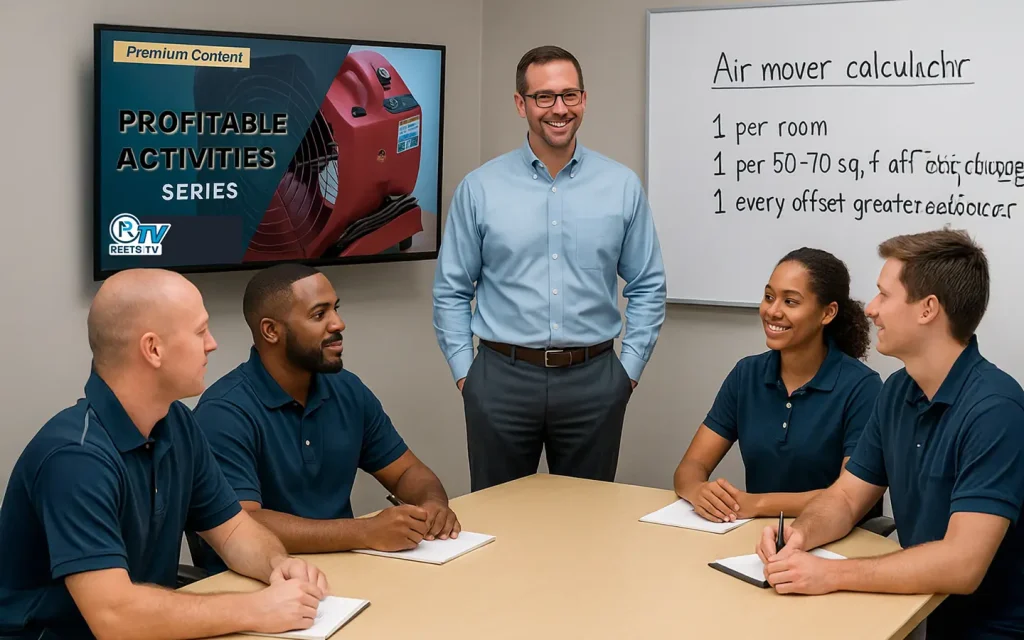
ReetsTV Streaming gives your team fast, focused training that fits into the workday. When managers notice a trend, you can target the training during morning meetings by using the ReetsTV Workbook Agenda. The workbooks make performing profitable morning meetings easy. It gives you the topic, the video to watch, an activity that helps techs get the point of the training and allows you to set a measurable standard they can reach.
ReetsTV Live makes interactive morning meetings even easier as a Reets Drying Academy instructor performs the meeting on a profitable activity.
ReetsTV Enterprise provides you with even more options. You can assign training by role, track progress across your team, and upload your own walkthroughs to teach company-specific processes. Enterprise also includes IICRC continuing education credits, so your techs are not just learning, they are building toward certified careers.
See how ReetsTV Streaming compares to Reets TV Enterprise and how they can support your team.
Start Retaining Your Team Today
Technician retention is not about doing one big thing. It is about doing the right small things consistently—setting clear expectations, listening to what your team needs, providing training that fits the job, and making space for growth.
Start by checking in. Ask what is working and what is not. Pay attention to how your techs are learning, where they are stuck, and what they want to learn next. Then put the systems in place that help them stay sharp and supported.
When you are ready to use training as a real tool for technician retention, Reets Drying Academy is here to help. If you can’t decide if you should choose ReetsTV Streaming or ReetsTV Enterprise, we put together a comparison between the two training platforms to help you find the best fit for your company.
Want help choosing the right option? Contact Rebekah at rebekah@reets.tv or call 770-712-7293.

Nick Sharp
Nick Sharp has worked with Jeremy Reets for nearly 2 decades. He started in carpet cleaning and mitigation before moving to the construction side as a project manager. He then was the senior estimator for Champion Construction for over 8 years. Since its inception in 2015, Nick has been an instructor of our Restoration Estimating & Negotiating course. His most recent venture is as a restoration estimate consultant. Nick is an Xactware Certified Trainer and also has his Levels 1-3 Xactimate Certifications. He’s a bad boy on that sketch but better at finding where you may be losing money!


770-712-7293