Table of Contents:
You can make a significant difference when dealing with adjusters if you use Evaporation Potential (EP).
Preparing properly for a job may save you from losing hundreds of dollars or even save a relationship with a referral source from deteriorating. Take a moment to think outside of the box when dealing with adjusters.
Look for the opportunity to explain a job that isn’t going to go as expected. When you are prepared, you have the right documentation, and you know how to explain drying, you will build relationships as opposed to damaging them.
To make the most of every job and avoid unnecessary pushback, here are the most effective ways to use EP when working with adjusters.
Always Communicate Early to Avoid Misunderstandings
Don’t wait till the end of a job to address an unexpected turn. Address the situation immediately.
When you tell someone something before it happens, you are a well-educated resource! If you wait until the job is at its end before explaining a potential unexpected turn, the perception of the other party is that you are an inept contractor trying to make excuses for poor quality work or overbilling.
If you are experiencing difficulty regularly in collecting on your water restoration work, it’s likely you are lacking upfront explanations..
At times it may be difficult to speak to an adjuster before the job is complete, but you can communicate with one of the decision-makers. Also, you can usually send an email or send a message to the adjuster.
Either way, explaining what will happen on a job as early as possible will increase your value.
How Does Evaporation Potential Help?
Water is removed in three processes: Extraction, Dehumidification, and Evaporation.
Evaporation takes the longest of the three. If there will be an issue on a job that causes it to take longer, it is usually caused by evaporation, and learning how to calculate evaporation potential helps you identify this early.
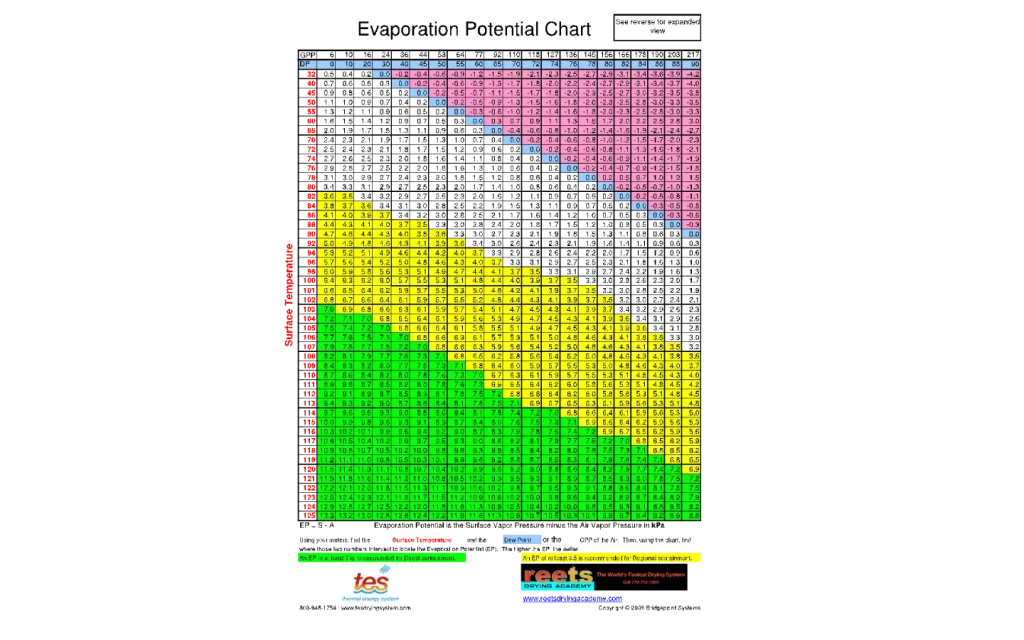
Evaporation Potential is a formula that was developed in 2004. EP helps restorers evaluate the effectiveness of the drying environment they have created. EP is an effective tool that has proven to help thousands of restorers.
Let’s say you have started a job and you get the best conditions available for drying water damage in the home!
The thermostat is set at 85 degrees and everything is ready to go. The following day you go to check on your readings and you notice the homeowner has lowered the thermostat to 72 degrees! This change in temperature potentially creates a drastic change in the drying environment, and subsequently, an increase in drying time!
The cost of the job will go up dramatically and then you are going to have to fight to explain why you should be paid for additional drying time. We know you are not responsible for this change in drying time, but unless you explain why early on, you could be held responsible.
If you just send a bill and try to excuse it later, it’ll be your fault. The problem is that GPP would not identify that this change in temperature is a problem. In fact, the GPP will likely improve and it would appear, incorrectly, that better drying conditions exist in the cooler environment.
When restorers explain the change using Evaporation Potential, they have dramatically greater success in not only getting fully paid, but they earn respect as a trusted adviser.
That’s why it’s important to understand how to calculate evaporation potential early and accurately on every job.
Using EP to Communicate Drying Conditions
Evaporation Potential helps you make your explanation by determining the rate of evaporation using the Surface Temperature, Air Temp, and Relative Humidity.
By decreasing or increasing those factors, you will either slow down or speed up the drying process, so knowing how to calculate evaporation potential gives you a clear picture of what’s really happening on the jobsite.
An EP goal of 1.5 or greater will give you the best results when using conventional drying methods. Directed heat drying is best done with an EP goal of 7 or greater.
Want to Get Better at Using EP in the Field?
You can learn how to calculate evaporation potential and apply it correctly by enrolling in the IICRC Water Damage Restoration Technician (WRT) Livestream Training from Reets Drying Academy.
The training covers how to set up drying equipment, monitor the job using meters, extract water with different tools, locate hidden moisture using infrared cameras, and applying psychrometric principles to calculate the right amount of equipment. It also explains how to make better drying decisions on-site based on real conditions.
The course now costs $249 instead of the usual $549, book your spot now!

Nick Sharp
Nick Sharp has worked with Jeremy Reets for nearly 2 decades. He started in carpet cleaning and mitigation before moving to the construction side as a project manager. He then was the senior estimator for Champion Construction for over 8 years. Since its inception in 2015, Nick has been an instructor of our Restoration Estimating & Negotiating course. His most recent venture is as a restoration estimate consultant. Nick is an Xactware Certified Trainer and also has his Levels 1-3 Xactimate Certifications. He’s a bad boy on that sketch but better at finding where you may be losing money!


770-712-7293


