Table of Contents:
Many in the restoration industry remediate fire-damaged properties. While doing so, they use terminology like smoke damage and soot damage interchangeably. What is smoke? What is soot? We also hear that smoke and soot aren’t dangerous. That anybody can clean buildings following a fire. Is that actually true?
What is Smoke?

Smoke is a superheated aerosol that is composed of gases (i.e. carbon monoxide, nitrogen oxides), vapors, and particles (i.e. soot, formaldehyde, benzene). If you’re in an area that has smoke, something is either still on fire or it’s just shortly after extinguishing something that was on fire. You probably want to vacate because it’s not very healthy. Smoke from a residential house fire may contain toxic substances like carbon monoxide, sulfur dioxide, hydrogen cyanide, and other chemicals that can be extremely harmful to inhale.
Contractors that restore fire damage projects should remove components that were damaged by the fire and can’t be restored. Following this demolition, restorers will clean particles of incomplete combustion from the property to save other components of the home or contents. Restoration contractors do not remediate or clean smoke. Another word that is used in the cleaning and restoration industry is soot.
What is Soot?
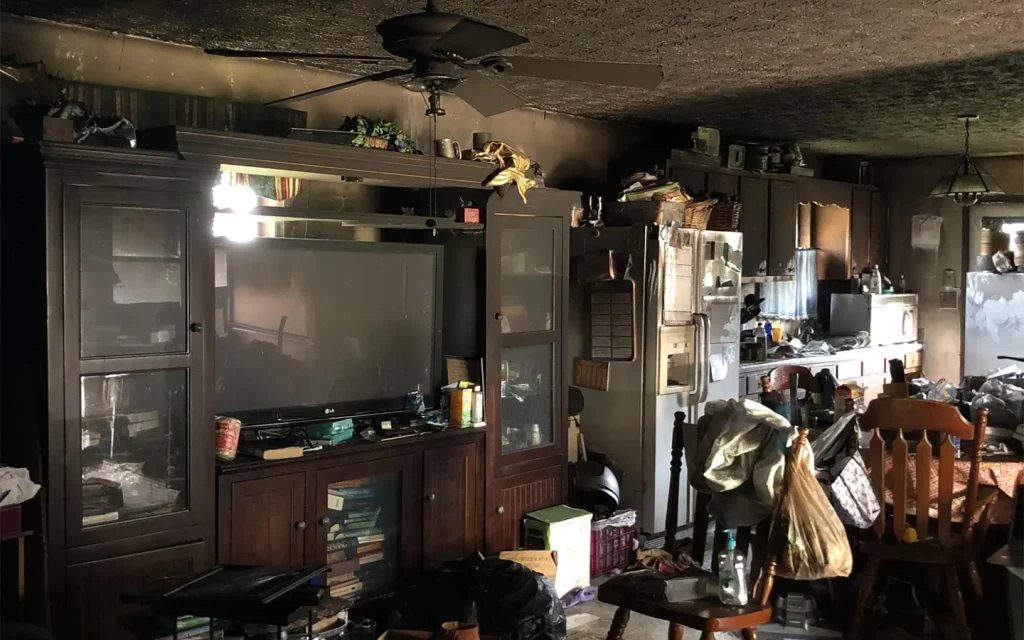
Soot is the residue left over after smoke has actually dissipated. Soot is something that’s created from a carbon, organic-based substance. It is composed of elemental carbon and numerous organic compounds. Soot is generated when the fuel is not completely combusted. Thus, the term particles of incomplete combustion (PIC) is often more accurate than soot. Some particles that make up soot are ultra-fine, measuring less than .1 microns in diameter.
Much of what a restoration contractor sees on the walls when they’re cleaning is going to be products of incomplete combustion, including soot. The residue left from smoke damage must be cleaned or removed. Restoration contractors can learn how to restore fire damage by attending an IICRC FSRT course (Fire and Smoke Restoration Technician).
Key Differences Between Soot and Smoke
Smoke and soot are both the result of a fire. Both elements are linked to various health issues. The differences between smoke and soot are when they occur on the timeline of a fire. Smoke is the various aerosols that are produced when there is a fire. Soot is the particles that may be in the smoke that remain after a fire has been put out. This residue is made up of particles that did not completely combust.
Aftermath of Smoke Damage
Smoke damage can affect a person or a building in various ways. Most people who lose their lives in a house fire are due to the smoke, not the fire. Even inhaling smoke from wildland fires can cause long-term health effects and even death. Fires in residential homes or commercial buildings have additional hazards as chemicals in the home or business combust. When items such as particle board, nail polish remover, or other chemicals ignite, they can create very dangerous compounds in the smoke.
These hazards may still exist in the home as a restoration company starts boarding up or remediating a home damaged by fire. Ensure the proper precautions, such as having a competent or qualified person conduct a hazard assessment and choosing and wearing the proper PP,E are taken.
Aftermath of Soot Damage
When the fire is extinguished and smoke is no longer being produced, there is often a residue left on the ceiling, the walls, and the contents remaining in the building. Many call this soot damage. Acidic soot damage can etch or even corrode the glass in windows and mirrors. Plastics, appliances, cabinets, and various fabrics can be permanently discolored due to soot damage. Particles of incomplete combustion can also affect HVAC components and electrical components.
PIC and soot damage should be cleaned according to the standards found in the ANSI IICRC s700 standard. If fire damage is not properly remediated, the remaining particles will present visual and olfactory issues. Remaining PIC can also present significant health concerns due to long-term exposure.
Health and Safety Risks: Soot vs Smoke
Both smoke and soot can pose significant health concerns. The PIC that may be in the smoke does not just dissipate with the smoke. Chemicals such as benzo(a)pyrene can pose significant risks to the property owner and to employees. Due to the particles being ultrafine, soot and other PIC can irritate the respiratory system, causing shortness of breath and coughing. Soot and other PIC can cause heart problems. PIC can even increase the risk of cancer.
When handling PIC and soot damage, the proper PPE is important. The correct respirator and cartridges, along with suitable coveralls, are necessary. As mentioned, the particles may be less than .1 microns in diameter.
This means the particles not only pose respiratory issues, but that they can pose absorption issues through your skin. As of the writing of this article, one of the leading causes of death for firefighters is not fire; it is occupational cancer due to exposure to carcinogenic compounds. Firefighters may be exposed for a few hours in full PPE to a fire.
Restoration contractors may be exposed to potential hazards for many hours while cleaning a fire-damaged building for days or weeks at a time. Some contractors do not wear the proper PPE because they do not know the risks involved. Contractors that do not test can’t know what hazards exist on the job site they are remediating.
Some contractors choose to use historical data when assessing fire hazards. This can leave contractors open to questions that are difficult to answer when the customer or an adjuster questions why they are using certain procedures or methods.
Using a third-party administrator to test for certain hazardous compounds before cleaning can mitigate this concern. Much better to do the right job for the right reasons and then justify why that is the right job than to not do the right job because of a fear of not getting compensated.
Conclusion
Remediating fire damage, smoke damage, PIC, or soot damage may be more hazardous than anything else restoration contractors do, including category 2 and 3 projects. A proper education is a good start. But applying that knowledge is key. Having a culture of safety should be of utmost importance to a business owner and should permeate the company.
Fire, smoke and soot damage should be properly remediated by a company that has a Hazard Prevention and Control System and the appropriate written programs, along with annual safety training. Management, estimators and technicians alike should all know the hazards as well as the proper cleaning methods when handling particles of incomplete combustion, soot, and smoke damage.

Nick Sharp
Nick Sharp has worked with Jeremy Reets for nearly 2 decades. He started in carpet cleaning and mitigation before moving to the construction side as a project manager. He then was the senior estimator for Champion Construction for over 8 years. Since its inception in 2015, Nick has been an instructor of our Restoration Estimating & Negotiating course. His most recent venture is as a restoration estimate consultant. Nick is an Xactware Certified Trainer and also has his Levels 1-3 Xactimate Certifications. He’s a bad boy on that sketch but better at finding where you may be losing money!


770-712-7293