The ANSI/IICRC S500 Standard and Reference Guide for Professional Water Damage Restoration exists to create consistency, accountability, and defensible decision-making. When adjusters or third-party reviewers look at a project, they don’t always know the most recent standards. But the question is…. Do you?
If the number of air movers used on a project doesn’t align with the S500, it can create questions about whether the project was dried efficiently—or even properly. It will also create negotiation challenges for estimators.
The Real Problem: Outdated or Incorrect Air Mover Formulas
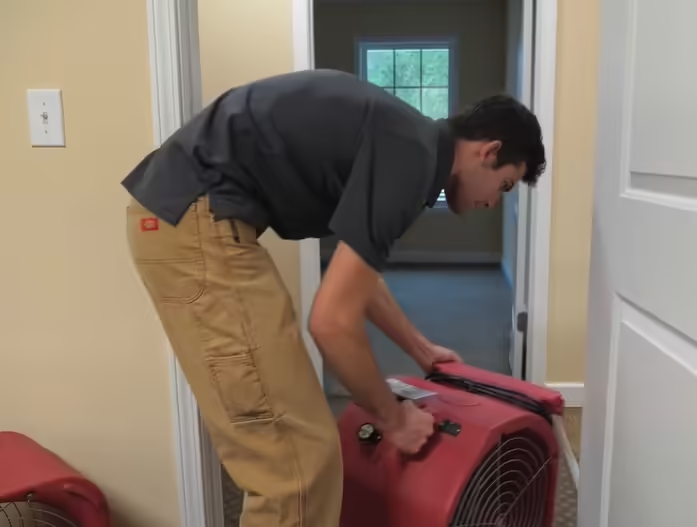
Here’s where things break down in the field:
- Some technicians were trained using older formulas that no longer apply
- Others were taught air movers are calculated by linear footage
- Some rely on apps without knowing what standard the app is based on
- Many crews simply match what they’ve “always done”
The current S500 formulas for air movers, dehumidifiers, and air filtration devices are specific for a reason. Air movement directly affects evaporation potential.
When air movers are not calculated, we find it leads to under-utilization in most cases. This can means:
- Drying will take longer
- Evaporation potential is affected
- The work is substandard
- Profitability is affected
- It puts other work into question
How Incorrect Air Mover Counts Affect Profitability
This isn’t just an operations issue, it’s a company-wide issue.
For technicians, incorrect air mover calculations can lead to:
- Lower commissions on performance-based pay
- Missed productivity bonuses
- Fewer opportunities for raises or promotions
Why would it affect a technician that much? Let’s look at an example. If 2 air movers were missed on a project at 30 dollars a day, that’s $60 missed per day. On a 5 day dry out, that would be $300. Over the course of a year, if your company did 300 projects, that would be a loss of $90,000! That loss is almost exclusively straight from the bottom line.
Simply put: When air movers aren’t calculated properly, it affects the company and you!
Stop Guessing. Start Calculating.
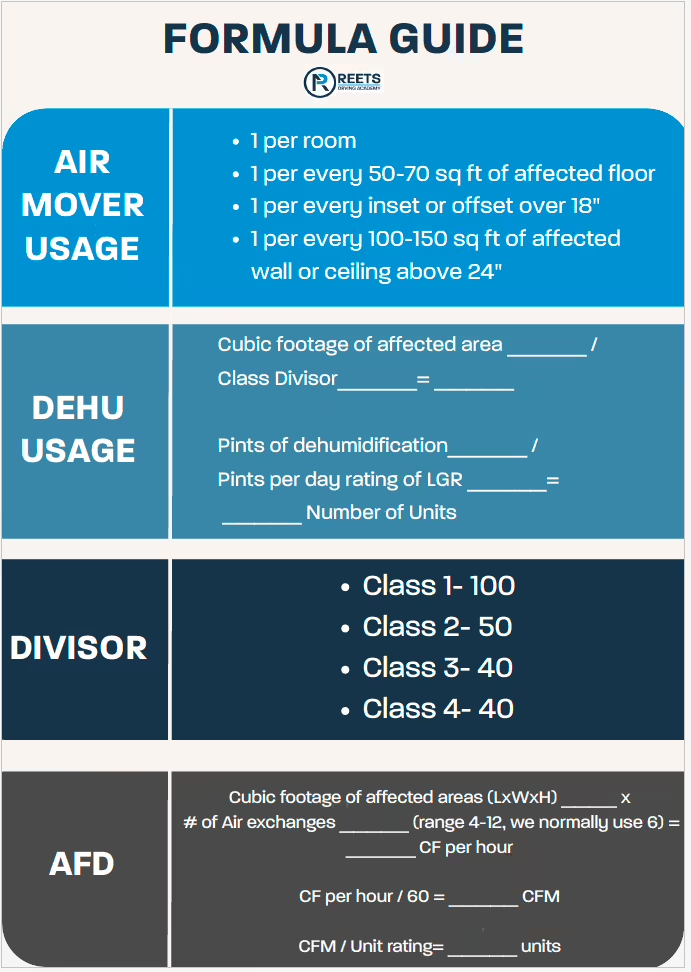
Water restoration professionals should never have to guess how many air movers to use. The formulas exist. And they’re part of the industry standard.
To make this easier, we’ve created a reference document that includes the correct and most up-to-date S500 formulas for air movers, dehumidifiers, and air filtration devices. This document can be used in the field, during scoping, or when reviewing a drying plan before deployment.
Using the S500 in Negotiations
Many estimators directly quote the S500 in their F9 notes. That is great! But simply quoting the standard isn’t enough. Estimators must understand the standards. The S500 uses the words “shall”, “should”, “recommended”, “can” and “may”. Each of these words have different meanings. Estimators must know if what was done is standard of care, or simply a recommended action based on circumstances.
Then, they must confirm that if the work was not under the standards, but simply recommended, if an agreement was made with the decision makers.This agreement should be documented as soon as possible.
Then, use the F9 notes in your estimate to document what the standard says and how the standard was applied on this project.
If the scope was based on an S500 recommendation, the F9 notes should remind the decision makers of the agreement reached earlier in the project.
Final Thought
Air movers are not just fans—they are profit drivers. When used correctly, they shorten drying time, protect structures, support documentation, and keep projects moving.
If you’re serious about professional water damage restoration, start with the standard that defines it.
Follow the S500.
Calculate with confidence.
And get paid for doing the job right.

Nick Sharp
Nick Sharp has worked with Jeremy Reets for nearly 2 decades. He started in carpet cleaning and mitigation before moving to the construction side as a project manager. He then was the senior estimator for Champion Construction for over 8 years. Since its inception in 2015, Nick has been an instructor of our Restoration Estimating & Negotiating course. His most recent venture is as a restoration estimate consultant. Nick is an Xactware Certified Trainer and also has his Levels 1-3 Xactimate Certifications. He’s a bad boy on that sketch but better at finding where you may be losing money!


770-712-7293