Table of Contents:
The restoration industry consistently underutilizes air movers, creating a cycle of inefficiency that affects every aspect of the business. When companies don’t follow proper calculation standards, they’re not just missing out on revenue, but compromising drying efficiency and quality of work.
The Cost of Underutilizing Air Movers
Most restoration companies are operating at 20-30% below their optimal air mover deployment, a gap that represents both a challenge and an opportunity for business improvement.
Let’s take a look at a real world example: when a project requires 15 air movers according to S500 standards but only 10 are deployed, this five-unit difference at $30 per day over a four-day drying period results in $600 in missed revenue per job.
Multiply this across 100 similar jobs, and the oversight amounts to $60,000 in lost profit. For a company operating at a 15% net profit margin, replacing this lost profit would require generating an additional $400,000 in revenue – a substantial amount of extra work that could have been avoided through proper initial calculations.
The path to consistent, profitable projects requires helping technicians understand both the technical requirements and the financial aspect of their equipment deployment decisions.
The math is simple… When teams don’t use enough air movers, jobs take longer to dry, which means paying more in labor costs while your equipment sits on jobs longer, preventing you from taking on new work.
Furthermore, inefficient drying processes can result in customer dissatisfaction and potential callbacks, creating a cascade of operational challenges that affect both immediate profitability and long-term business success.
Here’s a detailed overview of everything you need to know:
Hands-On Exercise: Comparing Estimates vs. Actual Needs
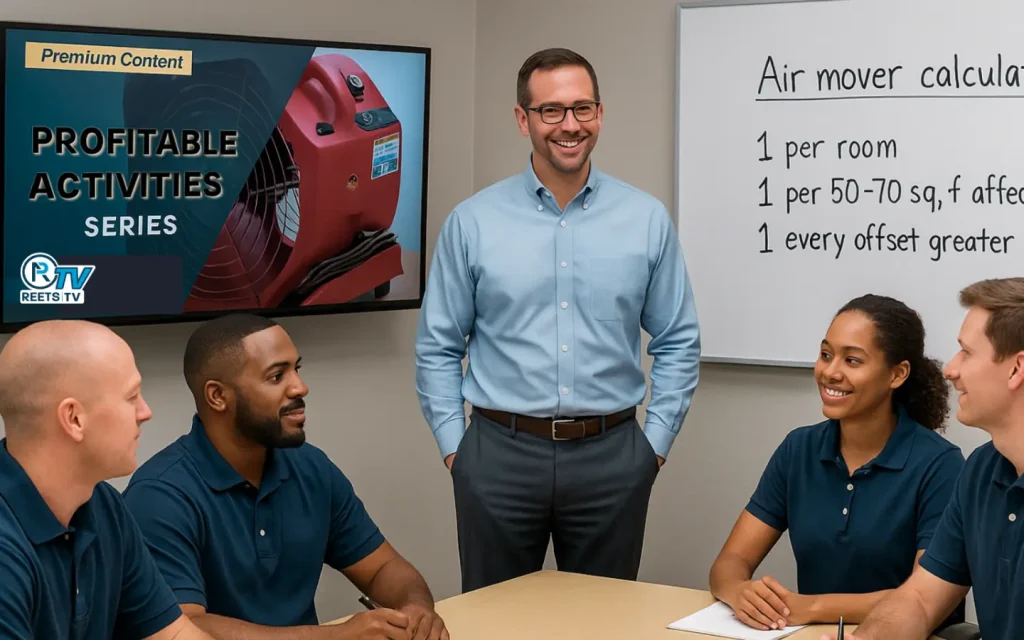
At your next team meeting, begin by having technicians assess a space using their current method of determining air mover needs.
Once they’ve recorded their initial estimates, guide them through the proper S500 calculation process, including the IICRC air mover calculation, to ensure they use the correct method for determining how many air movers are needed. You’ll then see how their estimates could be way off.
Here’s an example of what we mean by this. Let’s say experienced technicians might initially deploy 10 air movers based on their judgment, while proper air mover calculation IICRC guidelines indicate a need for 15 units.
Each air mover generates approximately $30 in daily revenue. With five fewer units than needed, your company loses $150 in daily revenue per job. Across a standard four-day drying period, this single job represents $600 in missed revenue. The impact becomes staggering when viewed across a year’s worth of jobs:
- Examining 100 similar jobs reveals $60,000 in annual lost revenue
- For a company operating at a 15% net profit margin, recovering this loss requires generating an additional $400,000 in revenue
You can print this air mover exercise for each technician and use it to guide them through the process.
When technicians see these numbers, they understand that proper calculations aren’t just about following rules, but they directly affect the company’s financial health and, by extension, their own earning potential.
How Miscalculations Hurt Profits AND Efficiency
Proper air mover calculations create a ripple effect throughout your restoration business. When technicians follow S500 standards, they ensure every project meets industry requirements, protecting both the company’s reputation and their professional credibility.
This standardization leads to consistently optimal drying conditions, therefore reducing the risk of callbacks and project delays that can drain resources and damage client relationships.
Moreover, proper calculations eliminate the need to generate additional business to compensate for lost revenue. Instead of spending time and resources finding new jobs to make up for losses, your team can focus on maximizing the profitability of existing projects.
This efficiency not only improves the company’s bottom line but also creates opportunities for enhanced compensation through proper equipment utilization.
Designing an Effective Incentive Program

With all of the things we’ve mentioned in mind, you need a simple but effective way to reward technicians for calculating air movers correctly. A good way to do this is by offering extra compensation when technicians properly calculate and document their air mover usage.
For example, offering $1 per day per air mover set can provide meaningful motivation while ensuring quality control.
To receive this compensation, technicians must:
- Calculate air movers according to the S500 standard
- Show their work through detailed documentation
- Provide proof they used the correct amount of equipment
- Submit complete drying documentation showing the project dried to completion
And since different crews may handle varying types of jobs, you should create a fair system for distributing incentives. You can do this by tracking air mover deployments monthly and distributing compensation based on each technician’s contribution to documented jobs.
For example, if your team sets 400 air mover days in a month at $1 per day, this creates a $400 incentive pool. If a technician worked 7% of the total hours on properly documented jobs that month, they would receive 7% of the incentive pool.
To help technicians improve accuracy, provide them with an easy-to-use air mover calculator so they can quickly determine the correct number of air movers required on-site.
Documentation Requirements and Verification

To make this program work, technicians need to document everything they do. That means calculating air mover usage on every project and showing their work. Here’s why documentation matters:
- Verification of Proper Deployment: Project managers can confirm that calculations match actual equipment placement and that drying goals are being met efficiently.
- Justification for Equipment Charges: When estimators see what might appear to be a high number of air movers, having detailed calculations based on industry standards provides the necessary support for these charges.
- Insurance and Client Communication: Having proper documentation makes it easy to show insurance companies and clients why you used each air mover
- Training and Improvement: Successful calculations can be shared during team meetings as examples of best practices, helping to continuously improve team performance.
Keeping Teams Engaged with Visible Progress Tracking
Maintaining a visual tracking system in the tech room, whether through a whiteboard or digital display, helps keep proper calculation practices at the forefront of everyone’s minds. This display should show:
- Monthly air mover deployment numbers
- Running totals of properly documented calculations
- Progress toward incentive goals
- Distribution of work hours across teams
Regular team meetings should include time to review successful calculations, discuss challenging scenarios, and reinforce the connection between proper calculations and business success. This ongoing dialogue helps maintain momentum and ensures the incentive program remains effective over time.
Want access to expert training videos to help your team improve air mover calculations and drying efficiency? Subscribe to Reets TV and get unlimited access to industry-leading restoration training content.

Nick Sharp
Nick Sharp has worked with Jeremy Reets for nearly 2 decades. He started in carpet cleaning and mitigation before moving to the construction side as a project manager. He then was the senior estimator for Champion Construction for over 8 years. Since its inception in 2015, Nick has been an instructor of our Restoration Estimating & Negotiating course. His most recent venture is as a restoration estimate consultant. Nick is an Xactware Certified Trainer and also has his Levels 1-3 Xactimate Certifications. He’s a bad boy on that sketch but better at finding where you may be losing money!


770-712-7293